TAAI 2026 海報小抄

11/21 13:00–14:20 · 2F 麗泉廳 · DP-28 · #198

場次資訊

時間
11/21(六)13:00–14:20,海報場次 6(國內場)
地點
2F 麗泉廳展示區,看板 DP-28
論文
#198
主持人
黃懷陞教授(北大資管)、孔垂暉(輔大)
報告規則
主持人巡場時每篇 3 分鐘,接著問答;全程待在海報旁
張貼
12:00–13:00(午宴時段)
撤場
14:20 場次結束即撤
最佳海報獎
看報告內容、清晰度、問答表現;16:30 5F 麗山廳閉幕式頒獎

海報地圖

講稿順序:① Motivation(右上)→ ② Fig. 1 架構(左上)→ ③ Methods(左下)→ ④ Studio(中右)→ ⑤ Results(下中)→ ⑥ Conclusions(右下)。點圖可放大。

3 分鐘講稿

約 380 字,以每分鐘 130 字估算約 2:55。先指到海報區塊再開口。

口語版,不是逐字翻譯;術語保留英文,方便對照海報。先指到海報區塊再開口。

1 0:00–0:30

Hook開場

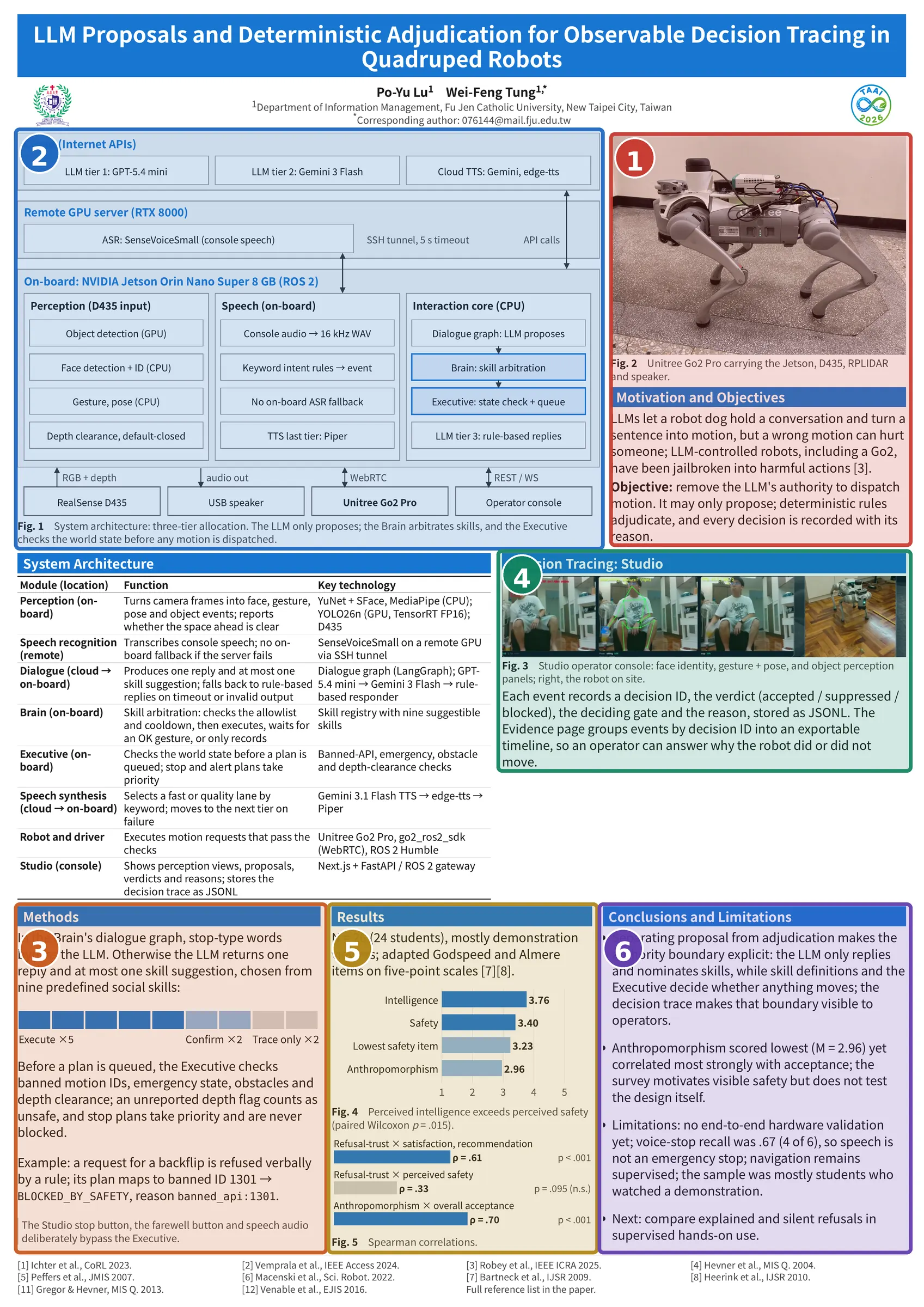
指:標題 → 右上 Motivation、Fig. 2

指:標題 → 右上 Motivation and Objectives、Fig. 2 機器狗照片
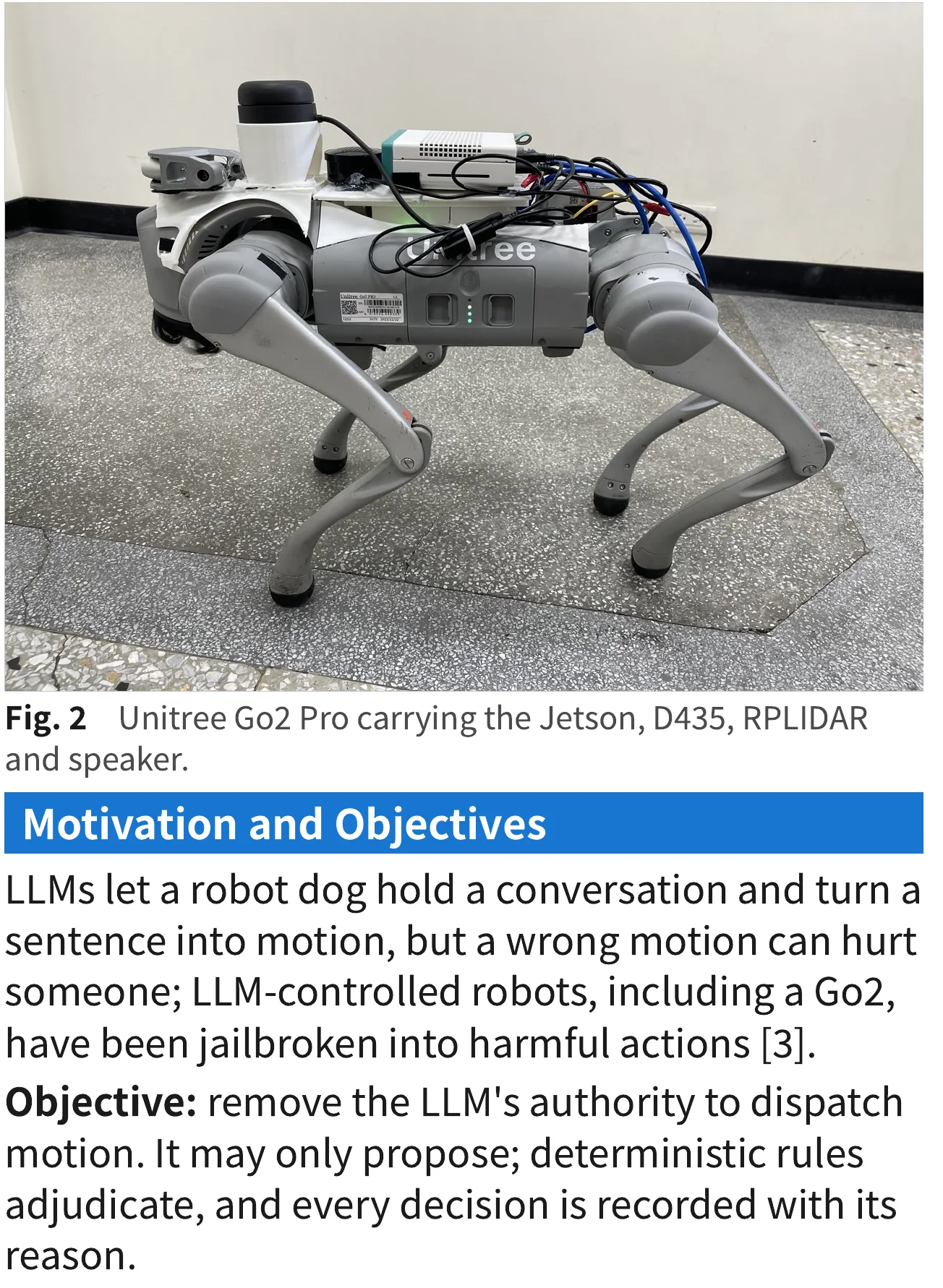
Fig. 2 and Motivation and Objectives

中文
老師好,我是輔大資管的盧柏宇。這是我們的 Unitree Go2 Pro 機器狗。有了 LLM,機器狗可以跟人聊天,還能把一句話變成動作。可是動作做錯是會傷人的,已經有研究把 LLM 控制的機器人,包括 Go2,越獄成做出危險動作。所以我們的目標很直接:把「讓機器人動」的權力從 LLM 手上拿走。

EN
Hi, I'm Po-Yu Lu from Fu Jen Catholic University. This is our Unitree Go2 Pro robot dog. LLMs let a robot like this hold a conversation and turn a sentence into motion. But a wrong motion can hurt someone, and LLM-controlled robots, including a Go2, have already been jailbroken into harmful actions. So our objective is simple: take away the LLM's authority to move the robot.

2 0:30–1:00

Architecture系統架構

指:Fig. 1 由上往下,停在 Interaction core

指:左上 Fig. 1,由上往下 Cloud → Remote GPU → On-board,最後停在 Interaction core 三格
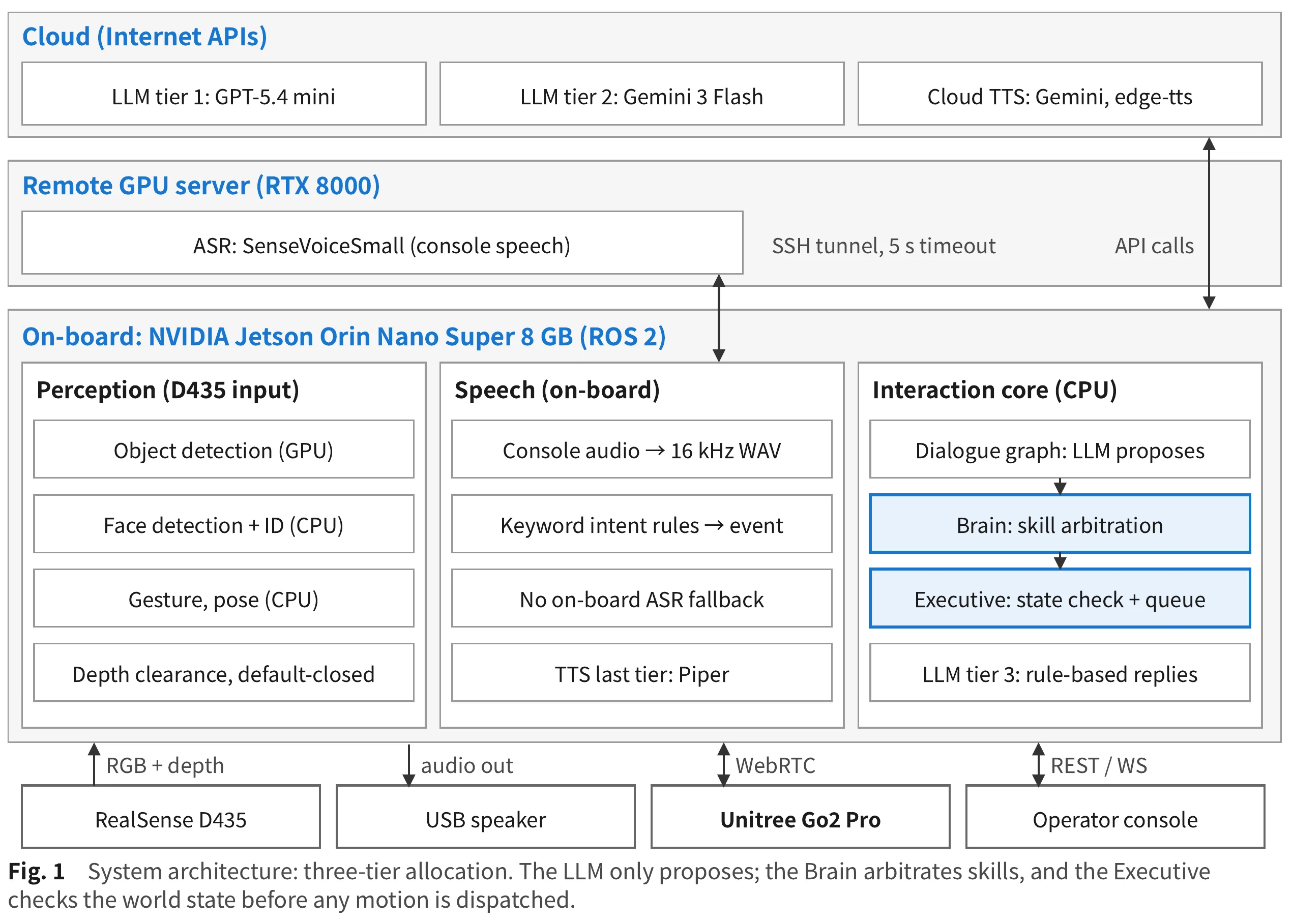
Fig. 1 system architecture

中文
整個系統跑 ROS 2,機上是 8 GB 的 Jetson Orin Nano Super。語言模型和語音合成在雲端,語音辨識放在遠端 GPU 伺服器,感知在機上跑。重點是這一塊互動核心:LLM 只負責提議,Brain 做技能仲裁,Executive 在任何動作送出前先檢查現場狀態。

EN
Here is the system. It runs ROS 2 on an 8 GB Jetson Orin Nano Super. Language models and TTS are in the cloud, speech recognition runs on a remote GPU server, and perception runs on board. The key part is this interaction core: the LLM only proposes, the Brain arbitrates skills, and the Executive checks the world state before any motion is dispatched.

3 1:00–1:50

Methods + backflip demo方法+後空翻示範

指:Methods 技能色條 → backflip 那行

指:左下 Methods 的技能色條(Execute ×5 / Confirm ×2 / Trace only ×2),最後手指停在 backflip 那行
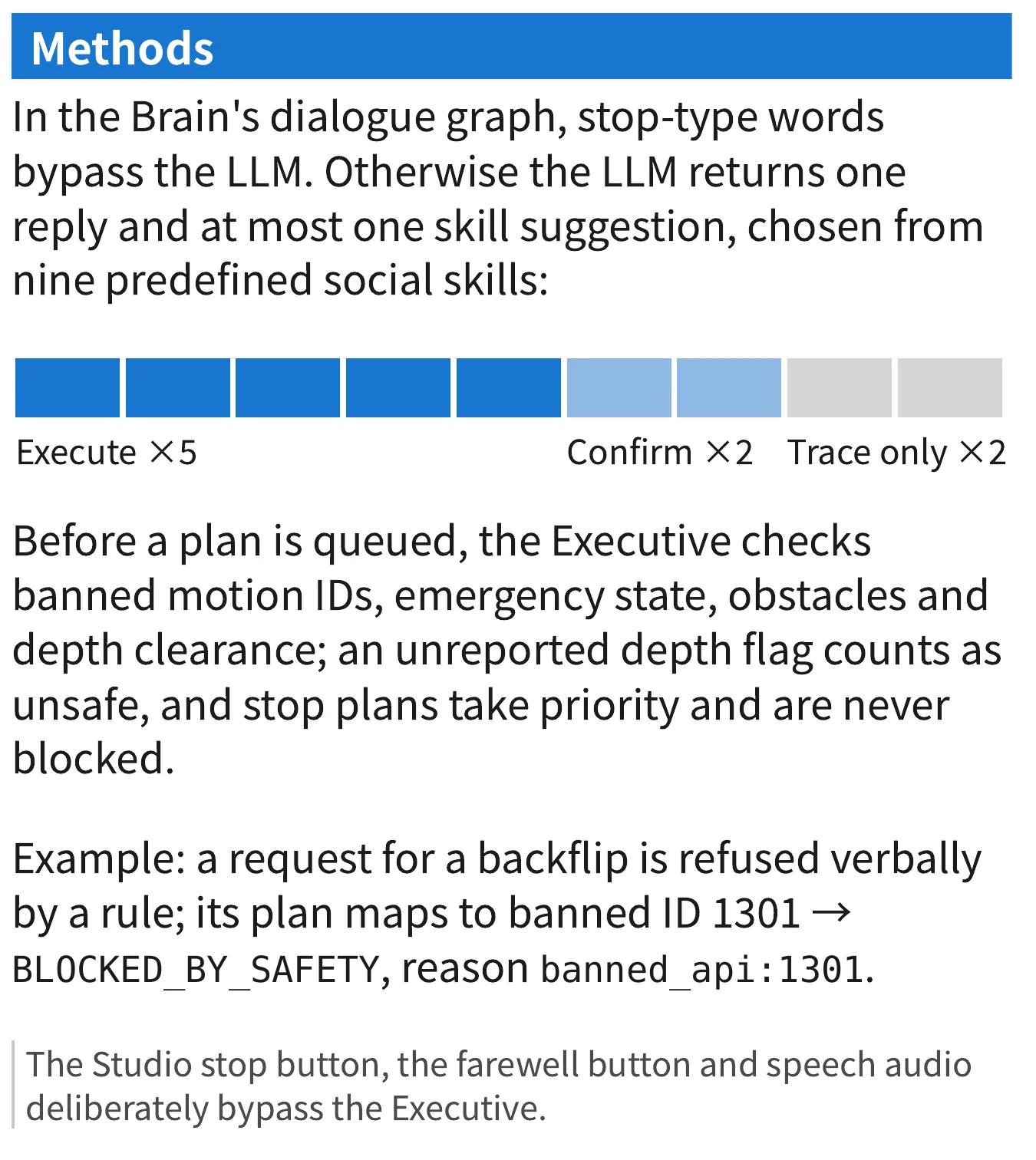
Methods section with skill bars and backflip example

中文
LLM 每次只回一句話,最多提議一個技能,而且只能從九個預先定義好的社交技能裡選。五個直接執行,兩個要對方比 OK 手勢確認,兩個只記錄不動作。聽到「停」這類字,直接跳過 LLM。計畫進佇列之前,Executive 會檢查禁用動作 ID、緊急狀態、障礙物和深度淨空;深度旗標沒回報就當作不安全,也就是 fail-closed。停止類的計畫永遠優先,不會被擋。舉個例子:你叫它後空翻,規則會先口頭婉拒;這個計畫對應到禁用 ID 1301,Executive 直接判 BLOCKED_BY_SAFETY,理由寫 banned_api:1301。

EN
The LLM returns one reply and at most one skill suggestion, from just nine predefined social skills. Five execute directly, two need an OK-gesture confirmation, and two are trace-only. Stop-type words skip the LLM entirely. Before a plan is queued, the Executive checks banned motion IDs, emergency state, obstacles and depth clearance. If the depth flag is not reported, it counts as unsafe. That's fail-closed. And stop plans take priority, so a stop is never blocked. Here's a concrete case. Ask the robot for a backflip. A rule refuses verbally, and its plan maps to banned ID 1301, so the Executive rejects it: BLOCKED_BY_SAFETY, reason banned_api:1301.

4 1:50–2:10

Studio traceStudio 決策追蹤

指:Decision Tracing: Studio、Fig. 3

指:中間右側 Decision Tracing: Studio、Fig. 3 截圖
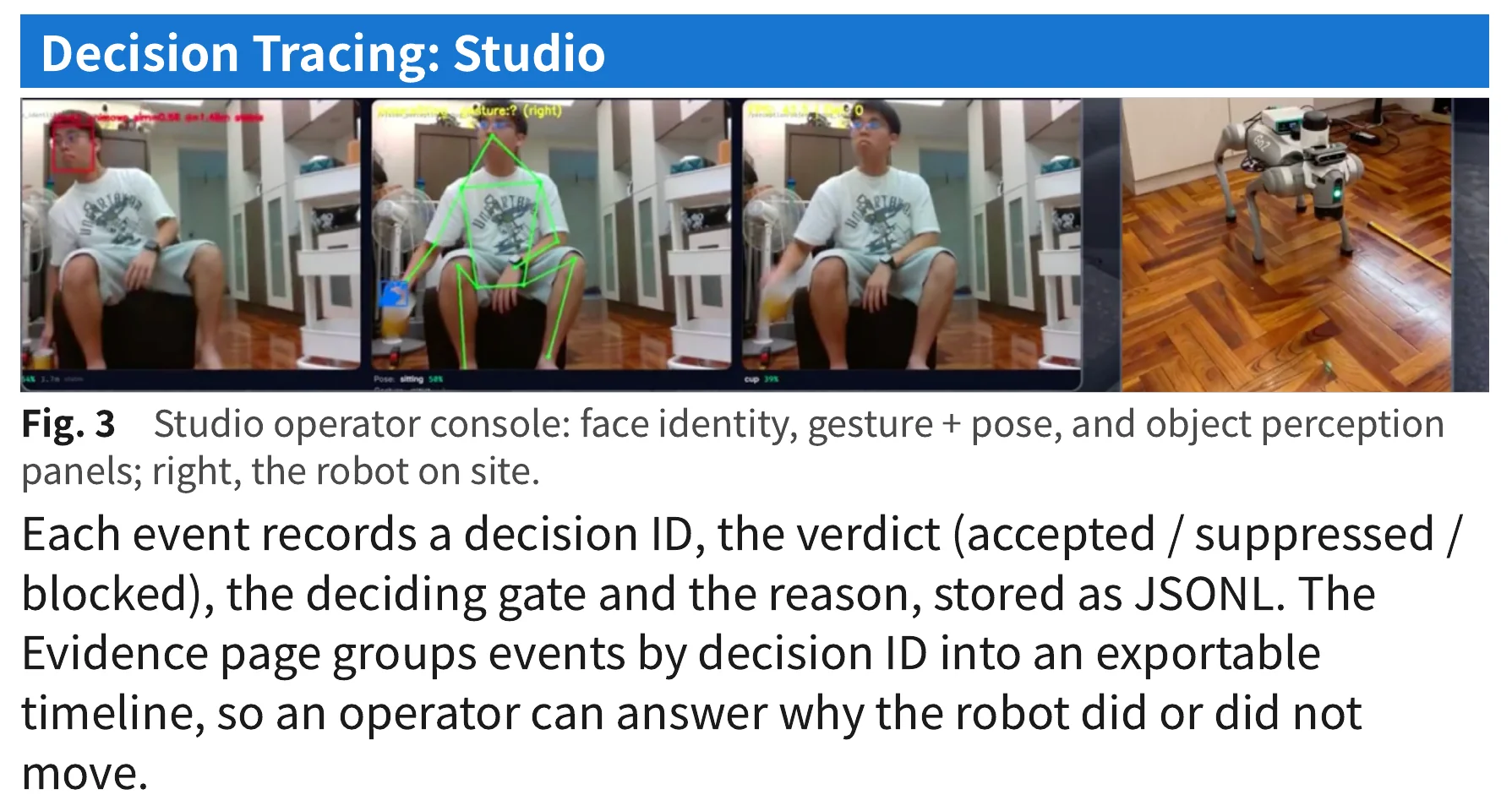
Decision Tracing: Studio and Fig. 3

中文
而且這個判定看得到。在 Studio 操作台,每一筆事件都記下決策 ID、判定結果、哪一道關卡做的決定、理由是什麼。Evidence 頁把它們排成時間線,操作員就能回答:機器人為什麼動、或為什麼沒動。

EN
And you can see that decision. In our Studio console, every event records a decision ID, the verdict, the deciding gate and the reason. The Evidence page turns them into a timeline, so an operator can answer why the robot did or did not move.

5 2:10–2:30

Results結果

指:Fig. 4 → Fig. 5 最下面一條

指:下方中間 Fig. 4 長條(3.76 vs 3.40),再指 Fig. 5 最下面那條 ρ = .70
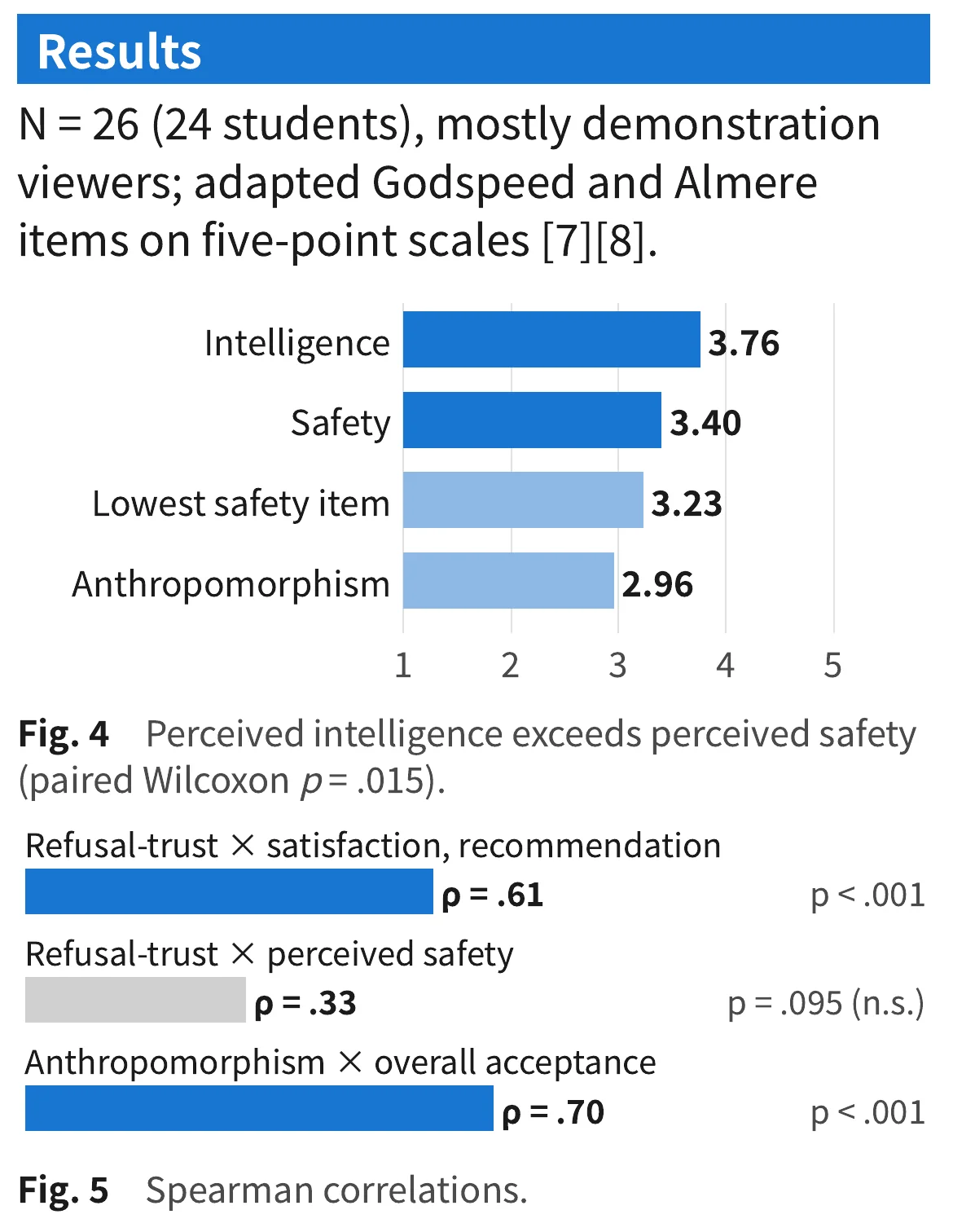
Results, Fig. 4 and Fig. 5

中文
我們做了 26 人的探索性問卷,大多是看示範影片的學生。智慧感 3.76,比安全感 3.40 高,paired Wilcoxon p = .015。擬人化分數最低,只有 2.96,但它跟整體接受度的相關最強,ρ = .70。

EN
We ran an exploratory survey with 26 people, mostly students who watched a demo. Perceived intelligence, 3.76, was higher than perceived safety, 3.40, paired Wilcoxon p equals .015. Anthropomorphism scored lowest, 2.96, yet it correlated most strongly with overall acceptance, rho .70.

6 2:30–3:00

Conclusion + limits結論與限制

指:右下 Conclusions and Limitations

指:右下 Conclusions and Limitations,依序點三個 bullet
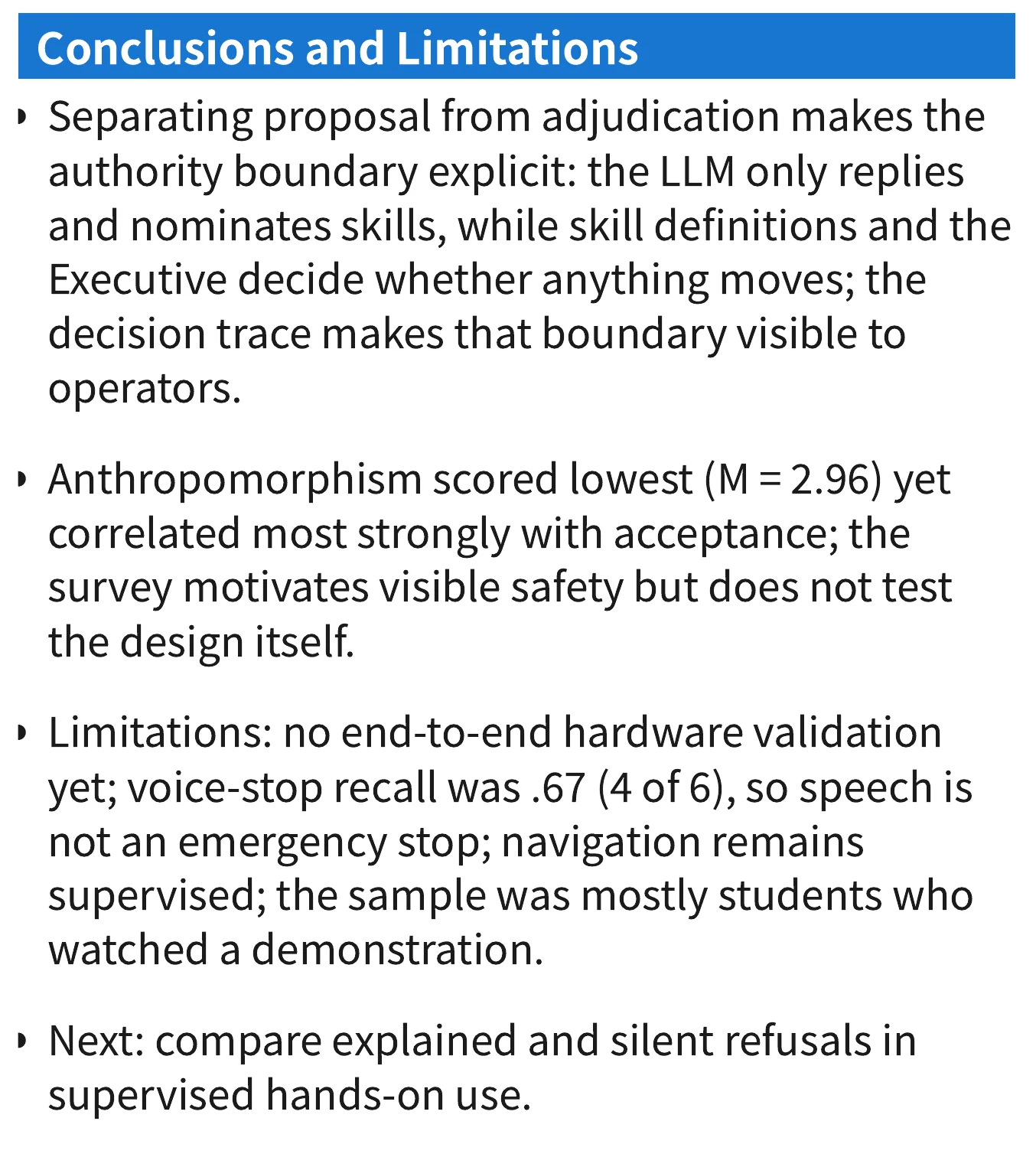
Conclusions and Limitations

中文
所以,把「提議」和「裁決」拆開,權力邊界就變清楚,決策追蹤再讓這條邊界看得見。限制我們也直接講:還沒有端到端的硬體驗證;語音停止召回率只有 .67,所以不拿來當急停;導航還是要有人監督。下一步,我們要在有人監督的實際互動中,比較「有解釋」和「沉默」的拒絕。謝謝,歡迎提問。

EN
So, separating proposal from adjudication makes the authority boundary explicit, and the trace makes it visible. To be honest about limits: no end-to-end hardware validation yet; voice-stop recall was .67, so speech is not an emergency stop; and navigation stays supervised. Next, we'll compare explained and silent refusals in supervised hands-on use. Thank you, I'm happy to take questions.
30 秒電梯版

主持人沒來時,路過的人用這個版本。

中文
我們的機器狗用 LLM 聊天,但 LLM 只能從九個固定技能裡提議一個,真正能不能動,由確定性的 Executive 決定,每一次判定都連同理由記在 Studio 裡。你叫它後空翻,它會被擋下:BLOCKED_BY_SAFETY,理由 banned_api:1301。26 人的探索性問卷裡,大家覺得它聰明(3.76)多過安全(3.40),所以我們認為安全不只要做到,還要讓人看得到。

EN
Our robot dog uses an LLM to talk, but the LLM can only propose one skill from a fixed list of nine. A deterministic Executive alone decides whether anything moves, and every decision is logged with its reason in our Studio console. Ask it for a backflip, and it's blocked: BLOCKED_BY_SAFETY, reason banned_api:1301. In a 26-person exploratory survey, people rated it more intelligent than safe, 3.76 versus 3.40, which motivates making safety visible, not just enforced.

可能提問 Q&A

答案只用論文與海報裡的事實;點題目展開。

Q1.Why not just filter the LLM's output, or use guardrails?為什麼不直接過濾 LLM 輸出或加 guardrail?

Filtering still leaves the LLM in charge of dispatch, and LLM-controlled robots, a Go2 included, have been jailbroken [3]. We remove that authority instead: the LLM gives only a skill name and arguments, motion IDs come from a static registry, a deterministic Executive decides, and a driver-level deny list repeats the banned IDs. Filtering could sit on top, but we did not compare against guardrail methods.

過濾後 LLM 還是握有下指令的權力,而 LLM 控制的機器人(包括 Go2)已被證明能被越獄 [3]。我們是直接拿掉它的權力:LLM 只給技能名稱和參數,動作 ID 來自靜態登錄表,由確定性的 Executive 裁決,驅動層的 deny list 再擋一次禁用 ID。過濾可以疊加,但我們沒有跟 guardrail 方法做比較。

Q2.How is this different from SayCan or ReAct?跟 SayCan、ReAct 有什麼不同?

Those works connect language models to robot actions or interleave reasoning with tool use [1], [16]. Our point is where authority sits: a mobile robot needs a separate authority boundary. The Brain nominates a skill; static skill definitions and the Executive decide whether any physical step is admissible. We did not benchmark against them.

那些研究是把語言模型接到機器人動作,或讓推理和工具使用交錯進行 [1]、[16]。我們關心的是「誰有權力」:會移動的機器人需要一條獨立的權力邊界。Brain 只提名技能,能不能做實體動作由靜態技能定義和 Executive 決定。我們沒有跟它們做 benchmark。

Q3.What about latency?延遲多少?

We don't report latency numbers in this paper. By design, stop-type words skip the LLM entirely, late or malformed LLM responses fall back to rule-based replies, and the ASR tunnel has a 5 s timeout. Measuring fallback latency is listed as future benchmark work.

這篇沒有報告延遲數據。設計上,「停」這類字直接跳過 LLM;LLM 回得太慢或格式錯,就退回規則式回覆;語音辨識的 SSH 通道有 5 秒逾時。fallback 延遲的量測列在未來的 benchmark 工作。

Q4.What if the LLM hallucinates a skill?LLM 幻覺出一個不存在的技能怎麼辦?

It can only nominate from nine predefined skills. The Brain checks the allowlist and cooldown, and the executable steps and motion IDs come from a static registry, never from the LLM. A malformed response falls back to rule-based replies, so a made-up skill has nothing to execute.

它只能從九個預定技能裡提名。Brain 會檢查 allowlist 和冷卻時間,實際步驟和動作 ID 來自靜態登錄表,不是 LLM 給的。格式錯誤就退回規則式回覆,所以編出來的技能根本沒有東西可以執行。

Q5.What does fail-closed mean here?這裡的 fail-closed 是什麼意思?

Depth-clearance and navigation-readiness flags default to unsafe when their publishers are silent. Obstacle, pause and missing depth clearance block plans with motion or navigation steps, and an emergency rejects every non-stop plan. Stop-priority plans bypass validation so a stop is never blocked. This is backed by code structure and unit tests, not yet end-to-end hardware validation.

深度淨空和導航就緒旗標,只要發布端沒訊息就預設為不安全。障礙物、暫停或缺少深度淨空,會擋下含動作或導航步驟的計畫;緊急狀態會拒絕所有非停止計畫。停止優先的計畫跳過驗證,所以停止永遠不會被擋。這些目前靠程式結構和單元測試支持,還沒有端到端硬體驗證。

Q6.Why isn't voice stop an emergency stop?為什麼語音停止不算急停?

In our June baseline, voice stop reached a recall of .67, four of six trials, which failed our zero-miss criterion. So speech is not used as an emergency stop. Stop words do skip the LLM, and there is a separate Studio stop button.

六月基準測試裡,語音停止召回率 .67(6 次成功 4 次),沒達到我們「零漏接」的標準,所以不把語音當急停。停止字詞仍會跳過 LLM,另外 Studio 也有獨立的停止鍵。

Q7.Can the depth gate stop navigation in progress?深度閘門能中斷正在進行的導航嗎?

Not yet. Depth gating can reject a new navigation goal, but it does not preempt one already underway. That's why navigation remains supervised and experimental.

還不行。深度閘門可以拒絕新的導航目標,但不會中斷已經在跑的導航,所以導航仍是有人監督、實驗性質。

Q8.The Studio stop bypasses the Executive. Isn't that a hole?Studio 停止鍵繞過 Executive,不是漏洞嗎?

It's deliberate, so a stop never waits on validation. Single adjudication holds only for the Brain-driven path; the Studio stop, the farewell button and speech audio bypass the Executive. The independent stop path and legacy publishers still need a dedicated audit before we make a broader safety claim.

是刻意的,讓停止不必等驗證。單一裁決只適用於 Brain 驅動的路徑;Studio 停止鍵、道別鍵和語音音訊都不經 Executive。這條獨立停止路徑和舊的 publisher 還需要專門稽核,在那之前我們不做更廣的安全宣稱。

Q9.How valid is a 26-person survey?26 人的問卷有多可信?

It's exploratory. 24 of 26 were students; 21 only watched a demonstration, 2 interacted hands-on, 3 did both. We used shortened Godspeed scales and uncorrected correlations, and we measured perceptions of the demo, not the Studio or the effect of showing traces. So the findings are hypotheses for a supervised study, not evidence of deployment readiness; physical presence may also change responses.

這是探索性的。26 人中 24 位是學生;21 人只看示範,2 人實際互動,3 人兩者都有。量表是縮短版 Godspeed,相關也沒做多重比較校正,而且量的是對示範的觀感,不是 Studio 或顯示決策追蹤的效果。所以結果只當作後續監督研究的假設,不代表可以部署;實體在場也可能改變回答。

Q10.What does the intelligence–safety gap tell you?智慧感高於安全感代表什麼?

Intelligence was 3.76 and safety 3.40, paired Wilcoxon p = .015; the lowest safety item was 3.23. People see the robot as smart before they see it as safe. Agreement that safety refusals increase trust correlated with satisfaction and recommendation (ρ = .61) but not significantly with perceived safety (ρ = .33, p = .095). It motivates visible safety control, but does not test it.

智慧感 3.76、安全感 3.40,paired Wilcoxon p = .015,最低的安全題 3.23。大家先覺得它聰明,還沒覺得它安全。「安全拒絕提升信任」跟滿意度、推薦意願相關(ρ = .61),但跟安全感沒有顯著相關(ρ = .33,p = .095)。這支持「安全要看得見」的動機,但還沒驗證這個設計。

Q11.Why does anthropomorphism matter if it scored lowest?擬人化最低分,為什麼還重要?

It was the lowest dimension (M = 2.96) yet correlated most strongly with overall acceptance (ρ = .70, p < .001). It's a correlation from an exploratory, uncorrected analysis, so it's not causal, but it suggests acceptance is tied to how lifelike the robot feels, which is worth testing.

它是最低的構面(M = 2.96),卻跟整體接受度相關最強(ρ = .70,p < .001)。這是探索性、未校正的相關,不是因果,但顯示接受度跟機器人像不像「活的」有關,值得之後驗證。

Q12.Why design science research?為什麼用設計科學研究法?

We follow design science research [4], [5]: we build and report an artifact and evaluate it. The contribution is an instantiated architecture and a testable mechanism, not a general safety theorem [11], [12], and this evaluation is the exploratory first round.

我們依照設計科學研究法 [4]、[5]:做出一個 artifact、報告它、再評估。貢獻是一個實作出來的架構和可檢驗的機制,不是通用的安全定理 [11]、[12],這次評估是第一輪探索性的。

Q13.How do you fit everything on an 8 GB Jetson?8 GB 的 Jetson 怎麼塞得下?

We choose perception models as a concurrent portfolio, because a detector that excels alone may starve its neighbors of memory or accelerator time. Face and landmark paths run on CPU (YuNet + SFace, MediaPipe), object detection on GPU (YOLO26n, TensorRT FP16), ASR is offloaded to a remote RTX 8000, and language uses tiered cloud, local and rule-based routes.

感知模型是當成「同時要跑的組合」來挑,因為單獨最強的偵測器可能把旁邊模組的記憶體或加速器時間吃光。人臉和關鍵點跑 CPU(YuNet + SFace、MediaPipe),物件偵測跑 GPU(YOLO26n,TensorRT FP16),語音辨識丟到遠端 RTX 8000,語言走雲端、本地、規則式分層路線。

Q14.What happens if the network goes down?網路斷了會怎樣?

Dialogue falls back from GPT-5.4 mini to Gemini 3 Flash to a rule-based responder, and TTS has an on-board Piper last tier. Speech recognition has no on-board fallback if the server fails. Failures under network loss are something future benchmarks should report.

對話會從 GPT-5.4 mini 退到 Gemini 3 Flash,再退到規則式回覆;語音合成最後一層是機上的 Piper。但語音辨識伺服器掛掉的話,機上沒有備援。斷網下的失效情況是未來 benchmark 要報告的項目。

Q15.What's next?下一步是什麼?

Compare explained and silent refusals in supervised hands-on use, measuring predictability, perceived safety, comprehension and reliance, with intended care users and staff. Also end-to-end hardware validation, an audit of the stop path, and benchmarks for cross-module contention, fallback latency and network loss.

在有人監督的實際互動中,比較「有解釋」和「沉默」的拒絕,量可預測性、安全感、理解度和依賴程度,對象是目標照護使用者和照護人員。另外還有端到端硬體驗證、停止路徑稽核,以及跨模組資源競爭、fallback 延遲、斷網情況的 benchmark。

報告技巧

  • 3 分鐘是硬時間:練到 2:50 內講完,留時間給問答。
  • 第一句就講主張:LLM 只能提議,Executive 才能決定動不動。
  • 每一段手指先指到海報區塊再開口,評審看得到你在講哪裡。
  • 後空翻是記憶點:念出 BLOCKED_BY_SAFETY、banned_api:1301 時放慢。
  • 國內場中英文都可以,先看主持人用哪種語言開口再跟著用。
  • 被問限制就直接承認,再接論文寫的下一步;不要擴大宣稱。
  • 主持人沒來時,路過的人用 30 秒版本。
  • 13:00–14:20 全程不要離開看板。
評分重點 內容、清晰度、問答表現三項,Q&A 跟講稿一樣算分。

出發前檢查

狀態以 11/20 為準。勾選會存在這台手機裡。